
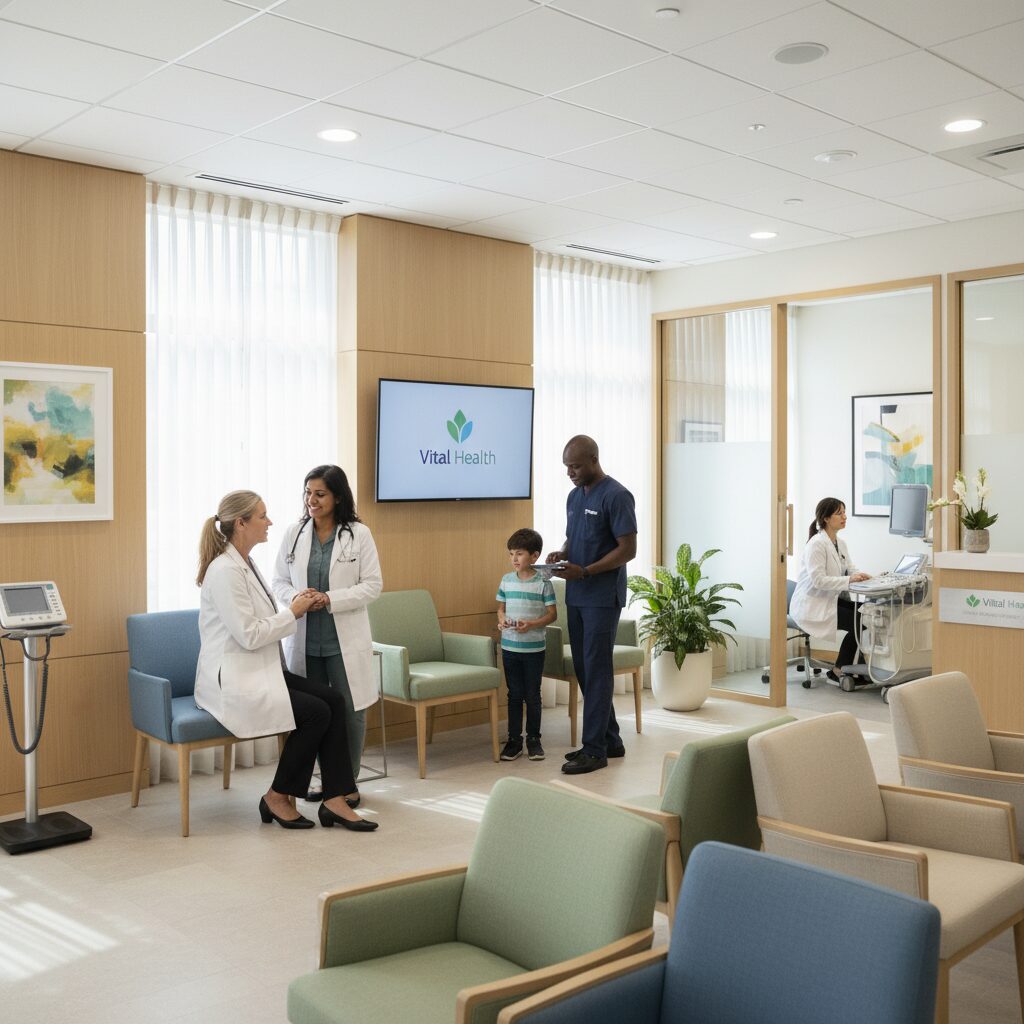
What a premium primary care experience really means
When you hear “premium primary care experience,” you might think of nicer waiting rooms or faster check‑in. In reality, premium primary care has much more to do with your relationship with your doctor, the time you are given, and how coordinated and proactive your care feels.
Research in England found that the single strongest driver of overall satisfaction in primary care is how well doctors communicate with patients, far more than how quickly you can get an appointment or whether you always see the same clinician [1]. That insight is at the heart of a premium experience. When you feel heard, respected, and clearly guided, your health decisions get easier and your outcomes improve.
At Vital Health, your experience is built around that kind of communication, continuity, and access, supported by both in‑person visits and telehealth so you can get care on your terms.
Why your choice of primary care matters
Primary care is not just a place you go for an annual physical. It should be the hub that coordinates every aspect of your health. The Centers for Medicare & Medicaid Services (CMS) describes high quality primary care as a long term relationship where your doctor understands your history, catches issues early, and helps you navigate specialists and treatment options [2].
When your primary care is working well, you are more likely to:
- Detect problems earlier through routine screenings
- Avoid unnecessary emergency room visits and hospitalizations
- Feel confident about your treatment plan and next steps
Premium primary care builds on this foundation with longer visits, easier access, and a team that looks at the big picture of your health, not just your most urgent symptom.
If you are comparing options like a best primary care clinic near me or choosing a new provider after a move, understanding these differences can help you find a true healthcare home instead of just another clinic.
The core elements of a premium primary care experience
A premium experience is not about luxury, it is about effectiveness and trust. Across health systems and innovative models of care, several elements consistently stand out.
1. Strong, consistent doctor communication
In a large primary care survey in England, communication with doctors was the strongest factor tied to how satisfied patients felt, more than double the impact of reception staff and far ahead of appointment access measures [1]. Patients in poorer health or with mental health conditions valued good communication even more, yet it remained the top driver for every group.
You feel this difference when your provider:
- Listens without rushing
- Explains options in plain language
- Invites your questions and preferences
- Summarizes the plan so you know exactly what to do next
At Vital Health, this type of communication is not a “nice to have.” It is built into scheduling, visit length, and follow‑up processes, which is one reason patients routinely rate us as a high patient satisfaction clinic.
2. A trusted, long‑term relationship
CMS highlights long term care relationships as a defining feature of high quality primary care, because your doctor can recognize subtle changes earlier and tailor recommendations to you, not just a diagnosis code [2]. This is what it feels like when you truly have a trusted healthcare home.
Over time, your provider gets to know:
- Your health history and risk factors
- Your lifestyle, work, and family responsibilities
- What motivates you and what makes change hard
That familiarity makes visits more efficient and more personal at the same time. It also supports continuity, which is central to how we practice as a continuity of care provider, coordinating with specialists, hospitals, and ancillary services so your care plan stays connected.
3. Proactive, preventive, and coordinated care
Premium primary care is not just reactive. It is designed to anticipate and prevent problems.
The CMS Innovation Center is investing heavily in care models that emphasize preventive care, early detection, and care management, because these approaches improve health outcomes and reduce the need for high cost interventions [2]. Health systems like Stanford have redesigned primary care to be more team based and coordinated, combining physicians, specialists, social workers, and home caregivers to manage complex needs and keep patients healthier at home [3].
In a premium primary care setting, you can expect:
- Routine health screenings that are explained clearly, not just ordered
- Follow‑up on abnormal tests and referrals, rather than you chasing results
- Support with chronic disease management, from medications to lifestyle strategies
- Coordination between your primary care, specialists, and community resources
At Vital Health, this big picture view is part of our identity as an integrated care provider. Your care is not a set of unrelated appointments. It is a coordinated plan.
How hybrid care elevates your access and convenience
Convenient access is an important piece of a premium primary care experience, but the solution is more nuanced than simply adding more appointments. The evidence from England showed that measures of appointment access, like getting seen quickly, had only a weak relationship with overall satisfaction compared with communication quality [1].
This tells you that access matters most when it is paired with high quality interaction. Hybrid models that combine telehealth and in‑person care can deliver both.
Telehealth plus in‑person visits
Direct primary care practices and concierge programs across the country are using virtual visits to expand access without sacrificing depth. For example, Gold Direct Care in Massachusetts offers longer visits and after hours availability, along with telehealth, while keeping pricing predictable and transparent [4]. Cleveland Direct Primary Care provides 24/7 phone access and same or next day appointments by using membership based primary care that is not restricted by traditional insurance rules [5].
At Vital Health, your hybrid experience lets you choose what fits best:
- In‑person visits for physical exams, procedures, and when you simply prefer face to face time
- Telehealth for follow‑ups, medication reviews, acute concerns that do not require a hands on exam, and quick check‑ins
If you value flexibility and still want strong relationships with your clinicians, a hybrid clinic telehealth & in person model can give you both.
Top tier telehealth as part of a premium experience
Not all telehealth is the same. A rushed video visit that feels transactional is not premium care. A well designed virtual visit can be just as thorough as being in the exam room, particularly when your provider already knows you.
You will notice the difference when your telehealth provider:
- Has access to your full chart and history during the visit
- Takes time to listen and examine what can be safely evaluated on video
- Orders tests or imaging when needed and helps you schedule them
- Communicates follow‑up steps through your online portal or secure messaging
This is what you can expect from a top rated telehealth provider that treats virtual visits as a continuation of an existing relationship, not a separate service line.
The human side: bedside manner and staff support
Premium primary care is a team effort. While doctor communication matters most, interactions with everyone you meet, from front desk to nursing staff, shape how safe and supported you feel.
In the same English survey, the helpfulness of receptionists was the second strongest driver of satisfaction in primary care, significantly more influential than appointment logistics [1]. That finding highlights how important it is that every person you encounter treats you with respect and responsiveness.
At Vital Health, this shows up in how you are greeted on the phone and in person, how questions are handled between visits, and how clearly next steps are explained before you leave. It is one of the reasons patients return and why we function as a retained patients clinic, building relationships that last for years, not months.
Data, outcomes, and what “quality” actually looks like
If you are comparing clinics, it can be hard to know how to judge “quality” beyond online ratings. A premium primary care experience is grounded in both patient experience and measurable results.
Evidence based, patient centered care
Health systems like Stanford have focused on redesigning primary care around evidence based, patient centered practices. That includes:
- Using research backed guidelines to drive screening and treatment decisions
- Coordinating communication between all members of the care team
- Paying attention to prevention and education, not just disease treatment
Their goal is to improve outcomes while also making care more affordable and aligned with how people actually live [3]. CMS is pursuing similar goals with value based care models that reward preventive care and thoughtful care management [2].
At Vital Health, those same principles guide everyday decisions. When you choose a quality primary care practice, you should see:
- Clear, consistent screening and vaccination practices
- Care plans that are adjusted based on your results, not left on autopilot
- Documentation and follow‑up that match what you discussed in the visit
Listening to patient stories and satisfaction
Numbers matter, but your own experience and that of other patients tells an important part of the story. A true award winning clinic does not earn recognition by accident. It comes from consistently positive feedback and measurable gains.
When you review a patient testimonials clinic, look for themes like:
- Feeling listened to and never rushed
- Clear explanations and education
- Smooth coordination with specialists and hospitals
- Reliable access by phone, portal, and telehealth
Those patterns suggest a culture that values your experience as much as your lab results.
How primary care models are evolving
Across the country, you can see several models of premium primary care emerging, each with a slightly different emphasis but a shared focus on access, personalization, and proactive care.
Direct primary care and membership based models
Direct Primary Care (DPC) practices remove traditional insurance billing for day to day primary care and instead use a flat monthly, quarterly, or annual membership fee. This often covers most clinical visits, basic lab work, and care coordination.
For example:
- Assurance Healthcare & Counseling Center in Washington offers unlimited access to medical providers for one monthly fee, with no copays or deductibles, and includes counseling as part of its membership so mental health is addressed alongside physical health [6].
- Gold Direct Care in Massachusetts charges memberships starting around $85 per month, focusing on longer appointments, better access, and transparent pricing that avoids surprise bills [4].
- Cleveland Direct Primary Care in Ohio provides same or next day appointments, extended visits, and 24/7 phone access as part of a simple, flat monthly rate with no hidden fees [5].
These models share key features of a premium primary care experience: time with your doctor, clear pricing, and a focus on the individual.
Concierge programs and advanced primary care
Concierge programs, like UH Select in Ohio, combine annual membership fees with traditional insurance billing and emphasize very small patient panels, longer visits, preventive care, and additional services like nutrition counseling, fitness assessments, and integrative therapies [7].
Advanced Primary Care programs, often adopted by employers, focus on improving health outcomes and lowering overall healthcare costs by providing onsite, nearsite, and virtual access, along with proactive chronic disease management. Employers using these models report lower total costs of care and fewer days lost to illness [8]. These benefits also help attract and retain talent because employees value easy, high quality access to care.
While the structure at Vital Health may differ from any single model above, the principles are similar. Your experience is built around accessibility, continuity, and comprehensive support, which is exactly what you expect from a boutique primary care provider focused on quality instead of volume.
How Vital Health sets itself apart
When you evaluate multiple providers, you are not just choosing a name. You are choosing how your care will feel in real moments, whether you are dealing with a new diagnosis, a lingering symptom, or a routine checkup.
Here is how your premium primary care experience with Vital Health stands out.
Deeper relationships and continuity
Your care team is designed so you can build a long term relationship with a clinician who knows you. We emphasize:
- Consistent providers whenever possible
- Thorough handoffs within the team when you do see someone new
- Active follow‑up after visits, tests, and specialist appointments
As a trusted family doctor clinic, we want your provider to feel like a familiar ally for every member of your household.
Hybrid access without sacrificing quality
You have access to in‑person care and high quality telehealth, with:
- Same or next available appointments for urgent needs when possible
- Thoughtful virtual visit scheduling that allows for adequate time
- Integration with your medical record, so every visit builds on the last
By bringing together in‑person and virtual options through our clinic differentiators primary care approach, we reduce your travel and waiting time without turning visits into rushed checklists.
Measurable quality, not just promises
Vital Health tracks and uses quality metrics to continually improve your experience. That includes preventive care completion, chronic disease measures, and patient reported satisfaction.
This focus is why we are recognized as a quality primary care practice and a trusted healthcare home. You benefit through:
- Fewer gaps in preventive care
- Clear reminders and education about follow‑up
- Consistent communication regardless of how you access care
Choosing the right premium primary care home
If you are deciding whether Vital Health is the right fit, it may help to reflect on what you value most. A helpful way to think about your options is to compare them across a few core dimensions.
Ask yourself: “Will this clinic know me, be reachable when I need them, and coordinate my care so I do not have to manage it on my own?”
Look for signs that a clinic is truly offering a premium primary care experience:
-
Relationship focus
Do you feel seen, heard, and remembered from visit to visit -
Communication quality
Are your questions welcomed and answered in understandable language -
Access and flexibility
Can you combine in‑person and telehealth in a way that fits your life -
Coordination and follow‑up
Does someone help you navigate tests, imaging, and specialists -
Evidence of patient satisfaction
Do reviews and testimonials sound like the experience you want
At Vital Health, these are not marketing phrases, they are operational priorities that shape how we schedule, staff, and support you. If you are ready for care that feels more personal, more coordinated, and more responsive, exploring a best primary care clinic near me that delivers a truly premium primary care experience is an important step toward better long term health.
